
How to Read the Little Mermaid with a Little Girl
What Hans Christian Andersen taught me about Love, Immortality and Being Human

The first thing you need to understand about mermaids is that all little girls, at some point, want to be a mermaid swimming out at sea with her dolphin best friend.
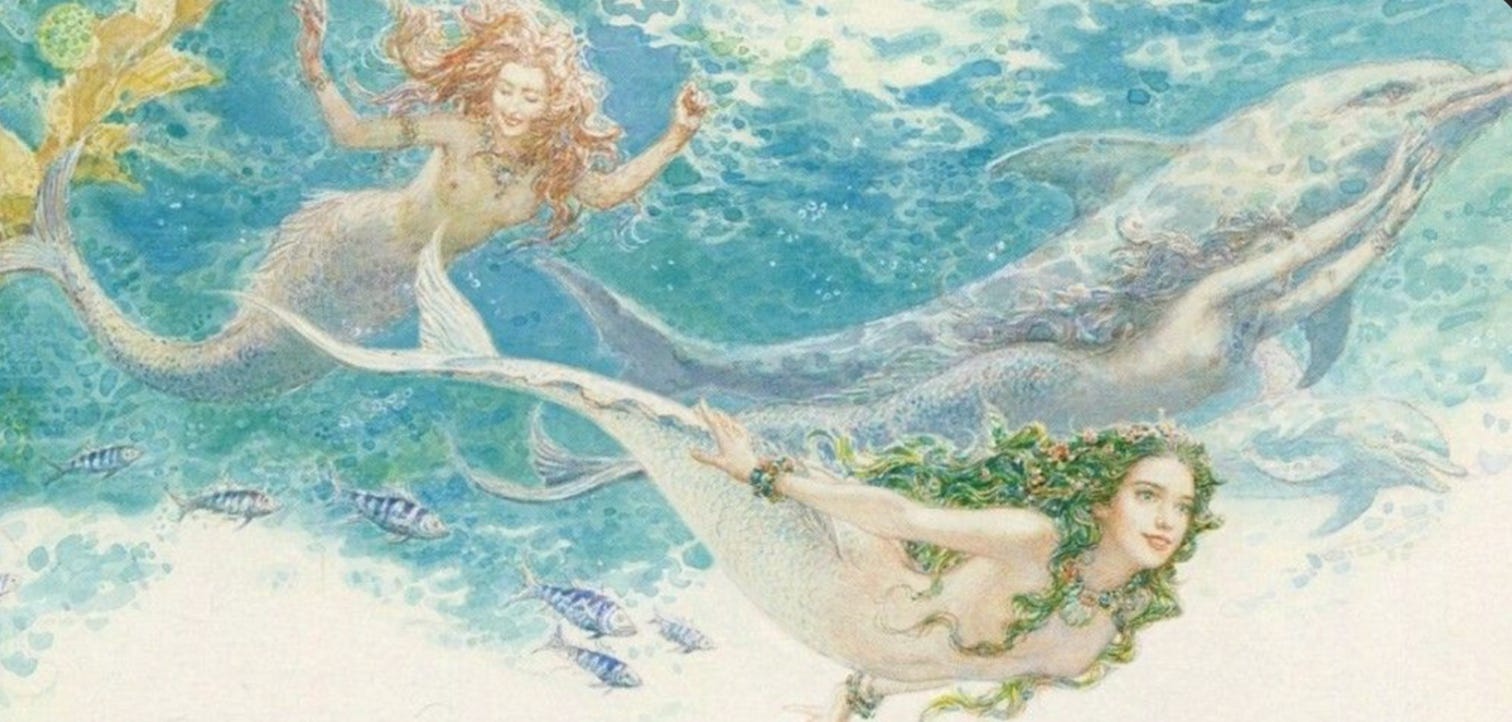
The sea calls to the gamine feminine spirit that wishes to be free of the chains of civilization in a way distinct from the masculine hermit because there is no hardship for a mermaid as there is for the hermit. The mermaid lives as effortlessly in the sea as a wave. The sea is a mythological symbol of the unconscious, with the dark side of the moon, the mysteries of the psyche, and women even as children understand they are a part of this mystery, to be experienced rather than understood. The hermit contends with nature whereas the mermaid subsumed as a part of it. To frolic in the moonlit waves and spend all their days doing nothing but having cheerful fun in the sea is the greatest expression of girlhood in mythology that there ever was. And that is what makes the Mermaid so dangerous to the little girl (and the woman she then neglects to become).
In his infinite genius, Hans Christian Andersen wrote a story particularly addressing the drama of the little girl in his fairy tale with the purpose of reminding her that however lovely it is to be a mermaid in her imagination, there is nothing so valuable as being a human girl because a human girl has an immortal soul.
Far out in the wide sea,—where the water is blue as the loveliest cornflower, and clear as the purest crystal, where it is so deep that very, very many church-towers must be heaped one upon another in order to reach from the lowest depth to the surface above,—dwell the Mer-people.
This is how Hans Christian Andersen’s fairy tale begins about the little mermaid princess who lived at the bottom of the ocean and fell in love with a human prince she rescues from a ship-wreck. When the cartoon film adaptation of the Little Mermaid came out in 1989, it was a huge success because of its spectacular music, hilarious characters, and of course Ariel’s adorable American sweetheart charm.
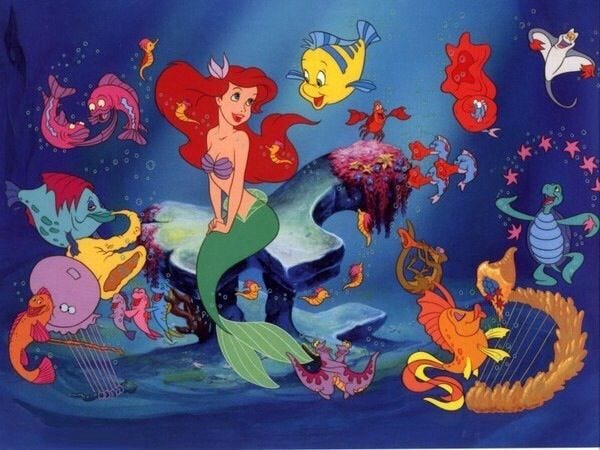
The film often got criticised later on by feminists because Ariel gave up her whole family, her voice and her mermaid tail in order to become a human being and be with Prince Erik. I found this criticism to be ridiculous because people make huge sacrifices all the time for love! But then I read Andersen’s original story…and it blew me away. I had tears in my eyes by the final paragraphs of the story. I was so shocked at how much more depth and beauty the original story had that the 1989 film never even touched. Although I still love Disney’s Little Mermaid, compared to the original story, it feels like nothing more than a silly little forgettable romcom.
If you’ve never read The Little Mermaid by Hans Christian Andersen, here is the link to the free pdf online. It will take you about an hour to read the whole thing; I read it with my two little toddlers and they were surprisingly captivated by it.
My first exposure to the story of the Little Mermaid was not Disney but rather an abridged adaptation of Andersen published by Honey Bear Books. When I was a child, we were quite poor living in Canada, and my mom got us books from the dollar store and it was from this treasure trove that I discovered this version of the Little Mermaid which still holds a special place in my heart because of how many times I read it at age seven.
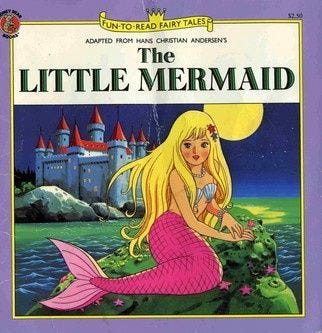
This version’s ending doesn’t show The Little Mermaid getting married to the Prince in the end, but rather, she is rescued from death by some flying spirits that take her away. I was so confused about how I felt about the ending. It wasn’t tied up in a neat little bow at the end like Snow White or Cinderella where the princess marries the prince and they ride off into the sunset. Disney’s 1989 version certainly forced this ending onto Andersen’s tale, and this is illustrative of one of Hayao Miyazaki’s criticisms of Disney, that it is uncomfortable with darkness and doesn’t know what to do with it. But Darkness has a place in children’s stories, and I have written about this here.
If the stories we tell our children try to pretend that darkness doesn’t exist, then darkness has a strange way of turning up in their lives in a far more attractive and enthralling way than it would if we showed it the respect it was due in the first place.
It would take me twenty-three years, reading Homer and a conversion to Catholicism for me to finally understand the ending of Andersen’s story. So that’s what this essay is about.
The Little Mermaid, despite being a heavy story, has a lot to offer to young children and especially to young girls that I think a modern leftist ideological world neglects us from understanding. This essay will help you refresh your heart and mind to see the true value in this story for yourself and for your children.
Here are the headings of the essay you can look forward to:
Teenage Rebellion vs Rite of Passage
Immortality & Heaven
The Sea Witch, Trans-humanism and the danger of witchcraft
Kiss vs Marriage as the Proof of Love
Deathless Death
Teenage Rebellion vs Rite of Passage
The first thing that struck me about Andersen’s story was the beauty of the writing. I believe that abridged classics deprive children of the beauty of the writing of original authors of such stories. The land of the mer-people is described with such detail and each detail is a magical one that refers to nothing we could have seen in reality. Everything blooms and glitters at once in the mind’s eye when we read Andersen’s descriptions of this magical world that does not exist. This stimulation of the imagination—the images of the mind—are precisely the beauty of storytelling that inspires other works of art of never before seen worlds.
Here is a little excerpt:
The sand that formed the soil of the garden was of a bright blue colour, something like flames of sulphur; and a strangely beautiful blue was spread over the whole, so that one might have fancied oneself raised very high in the air, with the sky at once above and below, certainly not at the bottom of the sea. When the waters were quite still, the sun might be seen looking like a purple flower, out of whose cup streamed forth the light of the world.
In the story, though the Mer-King is a widow, he has a mother who helps to look after his six daughters. The Little Mermaid is never given a name except that she is The Little Mermaid. The grandmother is shown to be a decent person who loves and cares for her princess grand-daughters.
Similar to the film adaptation, the Little Mermaid in the story too has a strange fascination with a human world and keeps a statue of a human boy in her garden. But unlike the film, her finally going to the surface is not a teenage transgression but rather a rite of passage. In the story, Mermaids come of age at fifteen years and after this, they are permitted to go to the surface and see the world of the land-walkers with their own eyes. In contrast, Ariel is portrayed as a minor child who transgresses against her father to see the human world. This is significant because in the movie then, a huge part of the conflict comes from Ariel disobeying her father.
Reading Andersen, the reader must wait just like the Little Mermaid does for her turn to see the world. The suspense builds with each of the older sisters sequentially coming of age and reporting back what they saw of the world. This builds a crescendo of anticipation toward the moment when the Little Mermaid can finally ascend to the surface herself.
When the Little Mermaid finally reaches her fifteenth birthday, she goes up to the surface to find a ship with a party on it, celebrating the birthday of a Prince with fireworks. For a mermaid to see fireworks would be one magnificent sight because nothing even close to this must exist in the under-water world. I liked the detail also that the Little Mermaid and the Prince share a birthday.
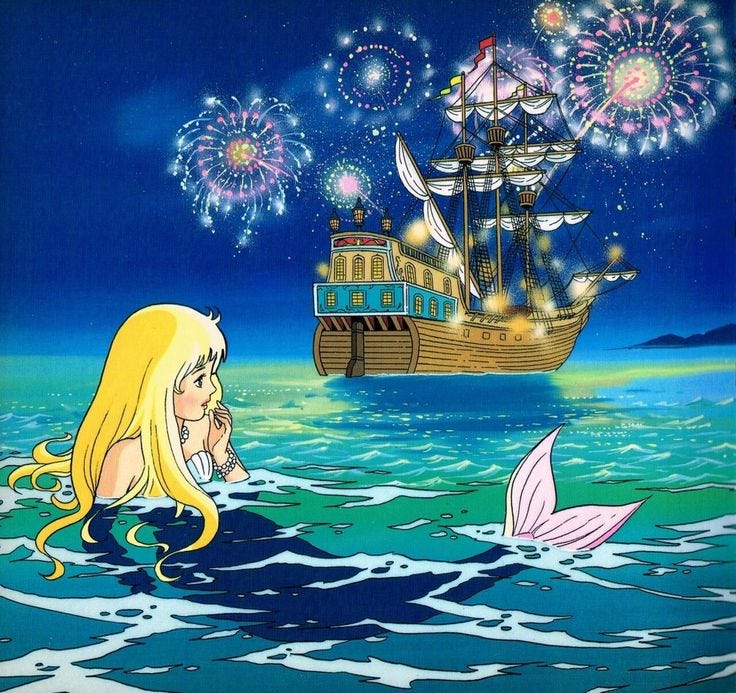
“However, she soon raised her little head again, and then it seemed as if all the stars were falling 10 down upon her. Such a fiery shower she had never even seen before, never had she heard that men possessed such wonderful powers. Large suns revolved around her, bright fishes swam in the air, and everything was reflected perfectly on the clear surface of the sea.”
This description by Andersen is so beautiful and powerful because it imagines how a mermaid, who had spent all her life in the ocean, might perceive and describe fireworks for the first time in her life.
Immortality & Heaven
It is quite interesting to see how each of the other sisters responds to the human world because it helps to highlight the strangeness of the Littlest Mermaid’s personality. The reader and the child both question where this strangeness in the Little Mermaid comes from; why is she so fascinated with the human world? In the film, the song “Part of Your World” the song insists that Ariel’s fascination might just be because the human world is forbidden. However in Andersen’s story, the Little Mermaid can see the human world as often as she wants to when she comes of age; her fascination is more profound, and it is similar to the yearning of Achilles and Faust: Immortality.
The Little Mermaid’s grandmother explains to her:
“We live to the age of three hundred years, but when we die, we become foam on the sea, and are not allowed even to share a grave among those that are dear to us. We have no immortal souls, we can never live again, and are like the grass which, when once cut down, is withered for ever. Human beings, on the contrary, have souls that continue to live when their bodies become dust, and as we rise out of the water to admire the abode of man, they ascend to glorious unknown dwellings in the skies which we are not permitted to see”
This is the heart of Andersen’s story. The Little Mermaid wishes to be human to be with the Prince, but far more than that, she yearns for an immortal soul so that she can one day go to heaven and evade death all together. Hans Christian Andersen was a Christian writer and as such, believed this truth sincerely. The Little Mermaid wanted eternal life which is offered only to human beings. The little girl who yearns to be a mermaid will, upon reading this detail, realize the value of her own soul even though she doesn’t have the chance to lead the mystical, wonderful adventures of the mermaid. Hans Christian Andersen reveals to us the gift of being human.
Even Achilles, for all his conquests, victories and virtues, ends up in the Odyssey as just a pathetic shade in Hades. It is not until Jesus Christ’s resurrection that the gates of heaven are opened and eternal life is possible for mortal human beings made in God’s image.
This element of the story was left out entirely from the Disney movie and this is what made the movie so much less profound and meaningful. Ariel in the movie only wanted to be with Prince Eric whereas Hans Christian Andersen’s The Little Mermaid wanted something far more important…and out of reach. She was chasing not just a silly little romance, but eternal life. In our own human sacrament of marriage, when we do it without God at the centre of it, we are liable to fail and divorce, ending the romance in heartbreak and misery. But when God is at the centre of the love story, you have a good chance of taking each other to heaven; not merely to love, but to love forever. Isn’t that what every Vampire Romance is truly yearning for?
What does it mean to be human? The Sea Witch and Trans-humanism
“He whom I love more than my father and my mother, with whom my thoughts are constantly occupied, and to whom I would so willingly trust the happiness of my life! All! all, will I risk to win him—and an immortal soul! Whilst my sisters are still dancing in the palace, I will go to the enchantress whom I have hitherto feared so much, but who is, nevertheless, the only person who can advise and help me” said the Little Mermaid.
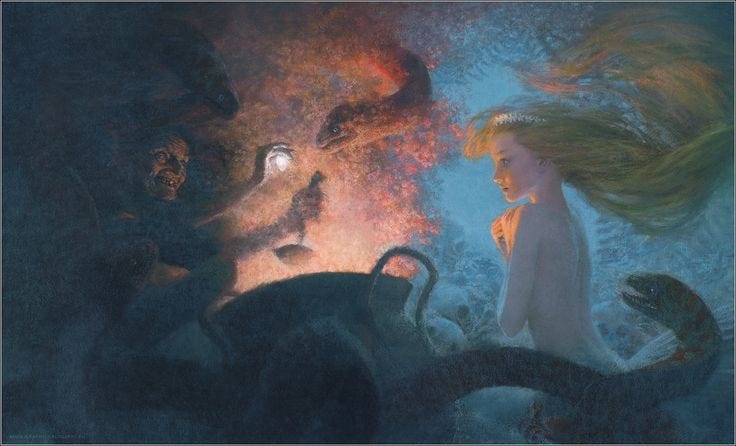
The Sea Witch is a transhumanist because she is a materialist. This is far less obvious in the movie than it is in the original story. In the movie, Ursula the Sea Witch believes that giving Ariel legs will make her human, and that only a mermaid tail separates the little nymph from being fully human. Based on the plot of the film, that is reasonable to presume. However, Andersen’s story reveals to us that there is a fundamental difference between mermaids and humans in their metaphysical essence itself because mermaids die like sea-grass that gets subsumed into the ocean, whereas humans have souls that can ascend to heaven.
The Sea Witch in the original Little Mermaid promises to her that if she marries a human prince, she can not only keep her legs, but she will also get a human soul because when they become one-flesh in the marriage ceremony, his soul will be shared with her. It was a shocking realization to see that the Disney movie had swapped the sacrament of marriage for a mere kiss. Yes, kisses are magical, but I think that this kind of messaging in media is meant to undercut the power of the sacrament of marriage itself. It makes sense in 1989 for them to do this at the height of Divorce Capital USA.
Just like how a mermaid cannot become human just by getting legs, a man cannot become a woman just by getting breasts appended onto his chest. There is an essential aspect of our being that cannot be altered. The Sea Witch is evil precisely because she tells the mermaid she can change her essence with a magic potion paid for by her tongue being cut out.
The Sea Witch does blood magic to make the potion for The Little Mermaid that turns her human, pouring a little of her own blood into the mixture. This is eery and interesting because blood magic is also used by actual satanists and witchcraft rituals in real life. Blood is powerful. It’s interesting that in Christianity it was Jesus’s perfect blood that made the most powerful sacrifice in human history and rendered all the rest of the sacrifices of mankind needless and powerless.
This story then is also a cautionary tale against witchcraft. However much it promises, it is always deceptive because it will never give you long-lasting happiness, only short-term bliss.
Kiss vs Marriage as the Proof of Love
The Prince finds the dumb Little Mermaid and thinks she is just a beautiful girl who looks vaguely like the one he remembers saving him from the ship-wreck. She lives with him as a consort or mistress, always by his side and worshipping him like an idol. He adores her and cares for her and even kisses her…but he does not make her his wife.
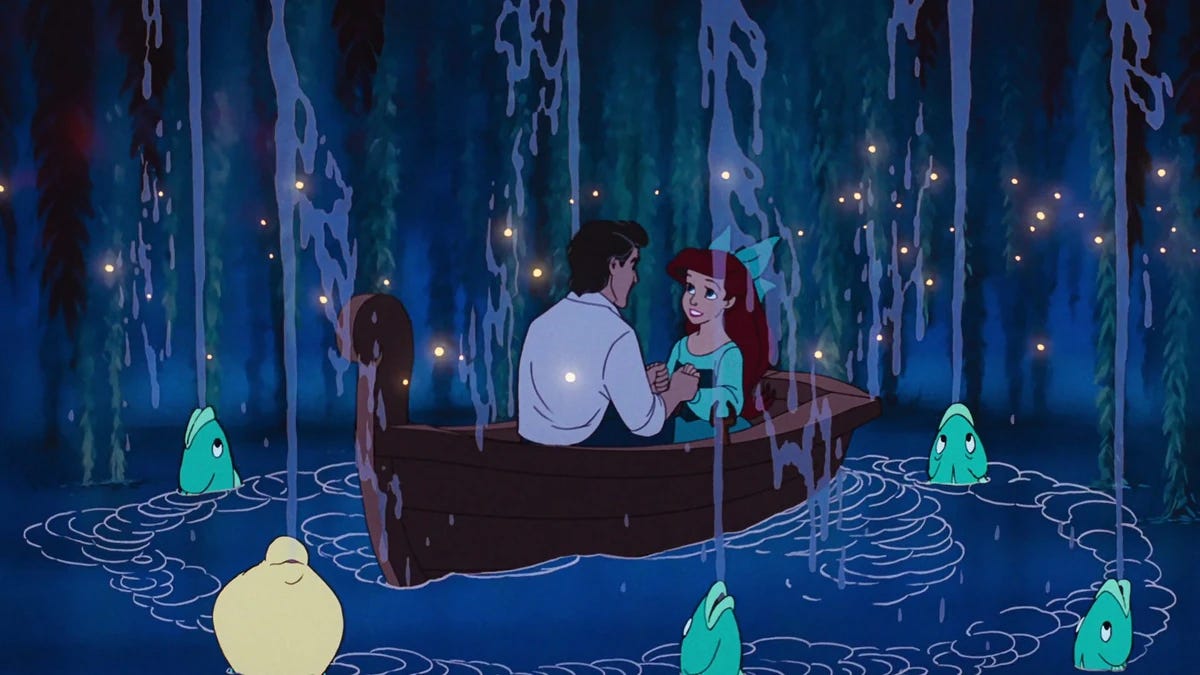
The movie the Little Mermaid tells little girls that the ultimate proof of True Love is a kiss. Whereas Andersen’s tail tells girls that a man might want to kiss a woman all the time and still he does not truly love her until he binds himself to her in the sacrament of marriage. This is a message that very few girls are given today and this is also what makes his fairy tale ring truer than the watered down and modernized Disney adaptation.
In Andersen’s tail, the Little Mermaid makes a similar judgement flaw that Juliet does in Shakespeare’s Romeo and Juliet and that many modern young lovers do: she worships a human being. If she had not worshipped the Prince, she could have judged him better and paid attention to his treatment of her. When the Prince ultimately marries another Princess instead of The Little Mermaid, she is utterly heartbroken.
Deathless Death
In the 1989 film, the Princess that the Prince is about to marry instead of Ariel is the Sea-Witch in disguise. This offers a convenient way for Ariel to win in the end by rescuing the Prince. However, in the original story by Andersen, things are more complicated because the Princess is describes to be a good person, and a beautiful human girl that the Prince genuinely falls in love with. There is no magic spell to assuage The Little Mermaid’s feelings. Her heartbreak is real and it is okay to share this moment of grief and frustration with children.
Modern storytelling wishes to protect children from all negative emotion and real pain but this does them a disservice; offer children flat stories and they will look for depth elsewhere, and those might not be salubrious places with good morals and virtues to direct that depth.
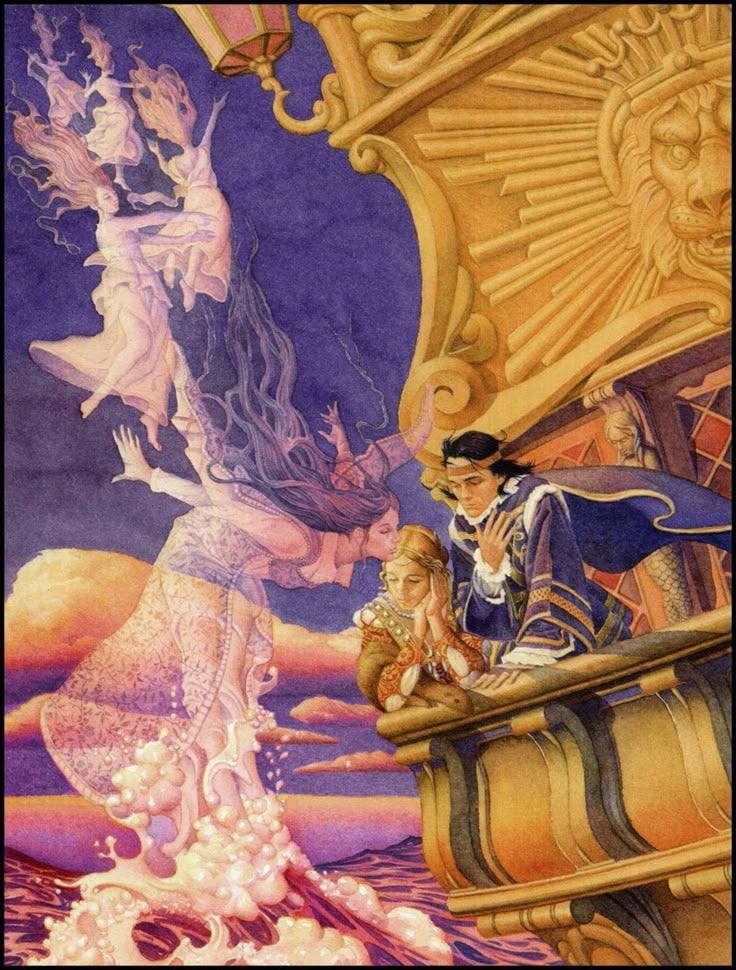
The Little Mermaid, because she has not married the Prince, is doomed to become sea-foam by sunrise as a part of the curse she signed up for with the Sea Witch. At the last minute, the Little Mermaid’s six sisters arrive, all with shorn heads as they reveal they exchanged their beautiful mermaid hair with the Sea Witch to buy an enchanted dagger from her so that the Little Mermaid might kill the Prince and become a mermaid again.
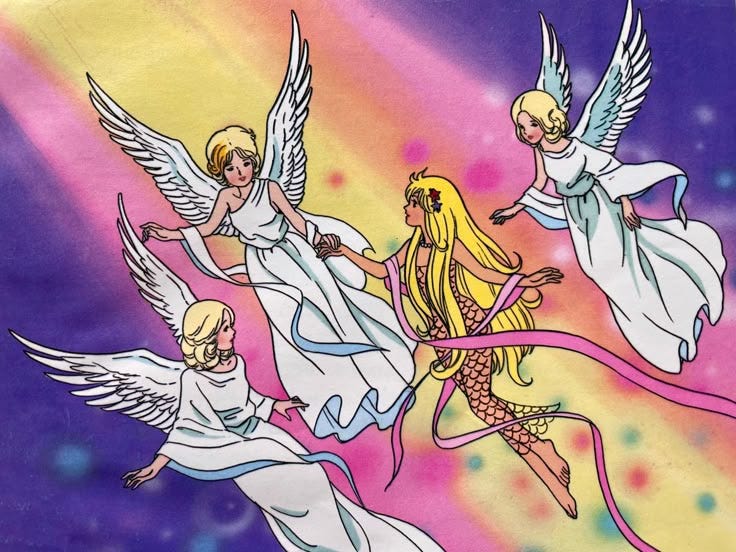
Because the Little Mermaid loves the Prince so much, and with a pure heart, she cannot bear to harm him or his bride. She overcomes her feelings of jealousy and fear and replaces them with perfect love. As a reward then, rather than becoming sea-foam, she is rescued by angels who take her up to the sky. They tell her that she can spend the rest of the life of the world looking after the little children in the world with them, like a guardian angel, and then one day she will be allowed to go to heaven with all the human souls.
Reading this ending brought a tear to my eye because it was so beautiful.
Despite the Little Mermaid folly in loving foolishly, trusting a sea-witch with witchcraft to change her body in unnatural ways, she was rewarded for loving with a good and pure heart. Though she would never be human, her wish for immortality was granted in a way she never expected.
Conclusion
The ending of the Little Mermaid is not easy or uncomplicated as Disney’s 1989 version makes it out to be. The Little Mermaid faces consequences for her actions. She doesn’t get all her mistakes erased by her father; she doesn’t magically get everything she wished for just because. But she does get a happy ending in a way that she didn’t expect to. The Little Mermaid teaches girls the values of their human souls, and the immortality that is available to them. It teaches girls not to change themselves completely to attempt to win the love of a man they idolize. It teaches them to not trust witchcraft to solve their problems, as it will likely just create more. And finally, it teaches little girls that one good deed, one moment of courage and true love, can make all the difference in the end.
Thank you for reading!
To support my work, please subscribe to my substack
Share this post with your friends
Or leave a like or comment to show that you appreciate it!
This has always been one of my favorite Anderson tales -- your breakdown of the story is one of the best analysis I've ever read. I think it's especially poignant to point at the teen rebellion vs rite of passage. It bespeaks to an underlying assumption society has that in order to grow up we must be be rebellious, and that teenagers are just that way.
Reading this undid and healed a lot of the detrimental disney programming I grew up with. Thank you so much for this! 🧜♀️🙌💚