
Reflections on Crime and Punishment
My experience reading Dostoevsky before versus after I became a Christian

It’s always a little intimidating to write after finishing a great work of literature; you ask yourself how you can possibly put anything to paper that would ever be worthy or necessary after someone else has said such important things, in such beautiful ways already. Nevertheless, this serves in a way to bear witness to what I have experienced, partly to make sense of it, and partly so that I don’t forget it myself--when passion is filed away in our memories, it has the tendency to be trimmed down to size. I am not in a competition to write the best Dostoevsky essay, I am here just to humbly bear witness to greatness in my own little way so that I can be another mirror to magnify the light.
The insidious proposition of modern philosophy is that there is no right answer that we can ever discern about difficult moral questions. Modern philosophers relish the vanity of their complex questions so much that they would take offence at a simple answer; they rebuke the simple truth. Like fish don’t notice the water they are swimming in, before I became a Christian, I did not feel my constant moral and existential confusion about the world to be abnormal or even wrong. The first time I tried to read Crime and Punishment, I was only eighteen years old and the moral questions proposed therein, by Raskolnikoff to himself, the characters to each other, and the demons that whispered and writhed in their acrid dreams, they all confused me to no end. I gave up on the story only to pick it up again nearly a decade later.
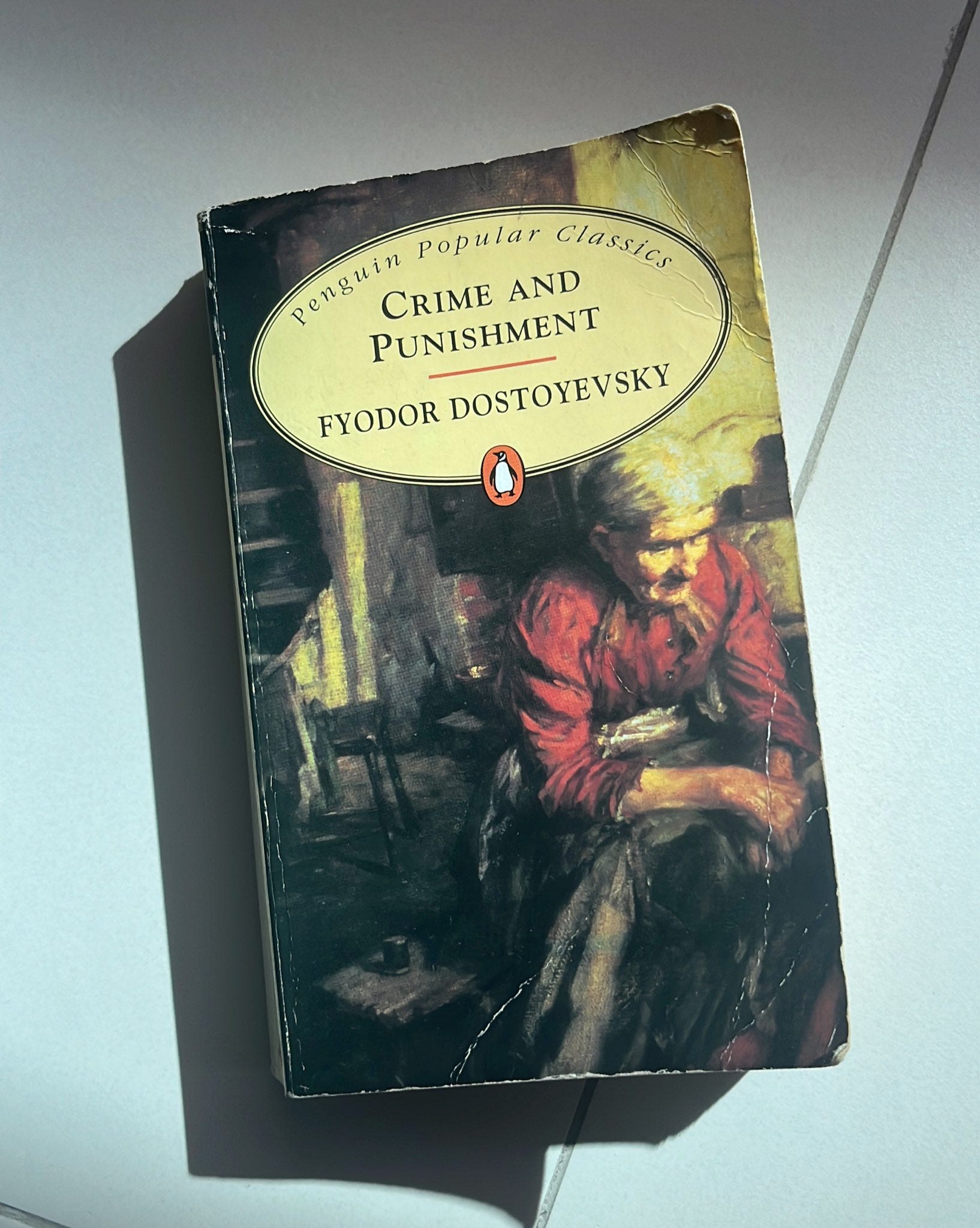
I had read Brother’s Karamazov several times in my twenties, Dostoevsky made me consider for the very first time that facts and reason alone, without divine grace and love, can lead us astray. The whole story of Brother’s Karamazov is a murder mystery turned on its head. A Sherlock Holmes materialist detective story is one in which inductive reasoning leads the reader and Mr. Holmes together to discover the culprit; all evidence ineluctably points to him. Whereas in The Brother’s Karamazov, all the evidence points to the wrong person, and we know this because we get to know the hearts and souls of the people involved and they indicate to us that there is something more than the material evidence at play. At this point in my life, I didn’t have the words, the syntax or the metaphysical language to articulate my morals. When my conscience said something, nudged me one way or another, could it be trusted? What was the principle that told me innocent life is worth protecting? Where do our morals even come from? My own upbringing and my family’s religion did not help me. Like modern philosophy, it hid behind complexity pretending to be wisdom.
But this time, when I read Crime and Punishment nearly six months after being baptised, there was a scene in Crime and Punishment that made it clear to me the profundity of the gift I had received, not merely from a spiritual perspective, but from an intellectual one (I hope I don’t insinuate here by accident that the latter is more important--it isn’t). The scene was about what is commonly called The Trolley Problem.
The Moral Calculation
