
How to Teach Real Art to a Child

Most people’s visual arts education often just begin and end with endless “crafts” that amount to so much garbage that parents guiltily store and then cull with every spring cleaning. Popsicle sticks, glitter glue, construction paper and recycled things are put together in Pinterest inspired craft instructions to make pencil holders, picture frames and paper-weights. I know these activities well because for six years, I taught “Arts and Crafts” to children while I volunteered. While these activities can be fun for children to do, are they really conducive to teaching them the fundamentals of real art?
Crafts on their own can be excellent ways to teach fine-motor skills to young children and as a form of art, they are an amazing way to teach children how objects can be repurposed in more than one way. A toilet roll can be glued to another one and it suddenly turns into binoculars. And who can forget the magic of unfolding a piece of white paper with its mystical little cuts, to reveal a beautiful paper snowflake! However the creativity of these crafts is often that of the teacher/parent rather than the child. What’s more, these crafts often substitute and supplant a real art education for children which has entirely different methods, benefits and ends.
When we read about the history of artists such as Bernini and Michelangelo, we learn that in Europe in the middle ages and the renaissance, art was not an idle pass-time for wealthy people, but rather a real mechanical skill that people took seriously even when they were children. Children are far more capable than the modern education system gives them credit for because the modern education system has devolved so much into baby-sitting rather than teaching.
Modern art education has no objective standards and anything a child scribbles together on a piece of paper has to be applauded like it is the exalted work of a prophet, but this deprives the child of a proper education. Just as a child would be lovingly corrected in their writing and grammar so that they can express themselves beautifully in the written word, so too must a child be corrected in their artwork. So many people also grow up thinking they can’t draw when they ever never taught the basics in the first place! Imagine how much more beauty we would have in the world if each person were given the ability to express themselves in the language of fine-art properly.
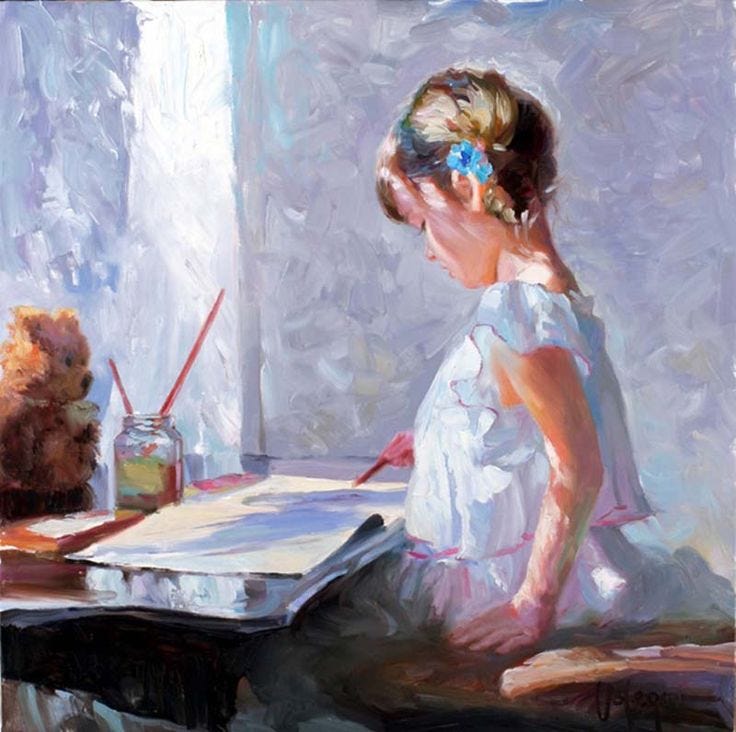
The first step to learning real art is to learn to see properly. This means learning to perceive the colours, shapes, forms, and light of the real world in such a way that we really pay attention to how they look. The best and most important steps to learning how to create and appreciate real art is to draw from life.
There are three main goals while teaching fine art. In this essay I include strategies that can be employed to teach each one. These skills, although outlined for children, can also be applied to adults who wish to improve their own fine art skills if they were never taught before and wish to learn! I have included references, books, materials, activities and much more in this essay. As a self taught artist who studied fine art for two years myself, I understand the value of being able to appreciate and create a beautiful image by hand.
