
Plato's Republic Book I Notes: Does Might Make Right?
Come read Plato's Republic with me!

PLATO’S REPUBLIC is a cornerstone of Western Civilization and because I owe so much of my life to Western Civilization, I believe I should take the time to read this wonderful work. I am planning to read, summarize and write my thoughts on each chapter of Plato’s Republic this summer and post them here! Even if you don’t have time to read The Republic this summer, by reading these summaries, you may get a glimpse into some of the wonderful ideas the book contains. And if you are reading it, it is all the better because you can post your replies and thoughts in the comments and we can discuss them!
There are many wonderfully written academic essays out there on The Republic and I may read them in the future, but I want to read this book for myself first and capture my first impressions, uninfluenced by outside sources that tell me what to think.
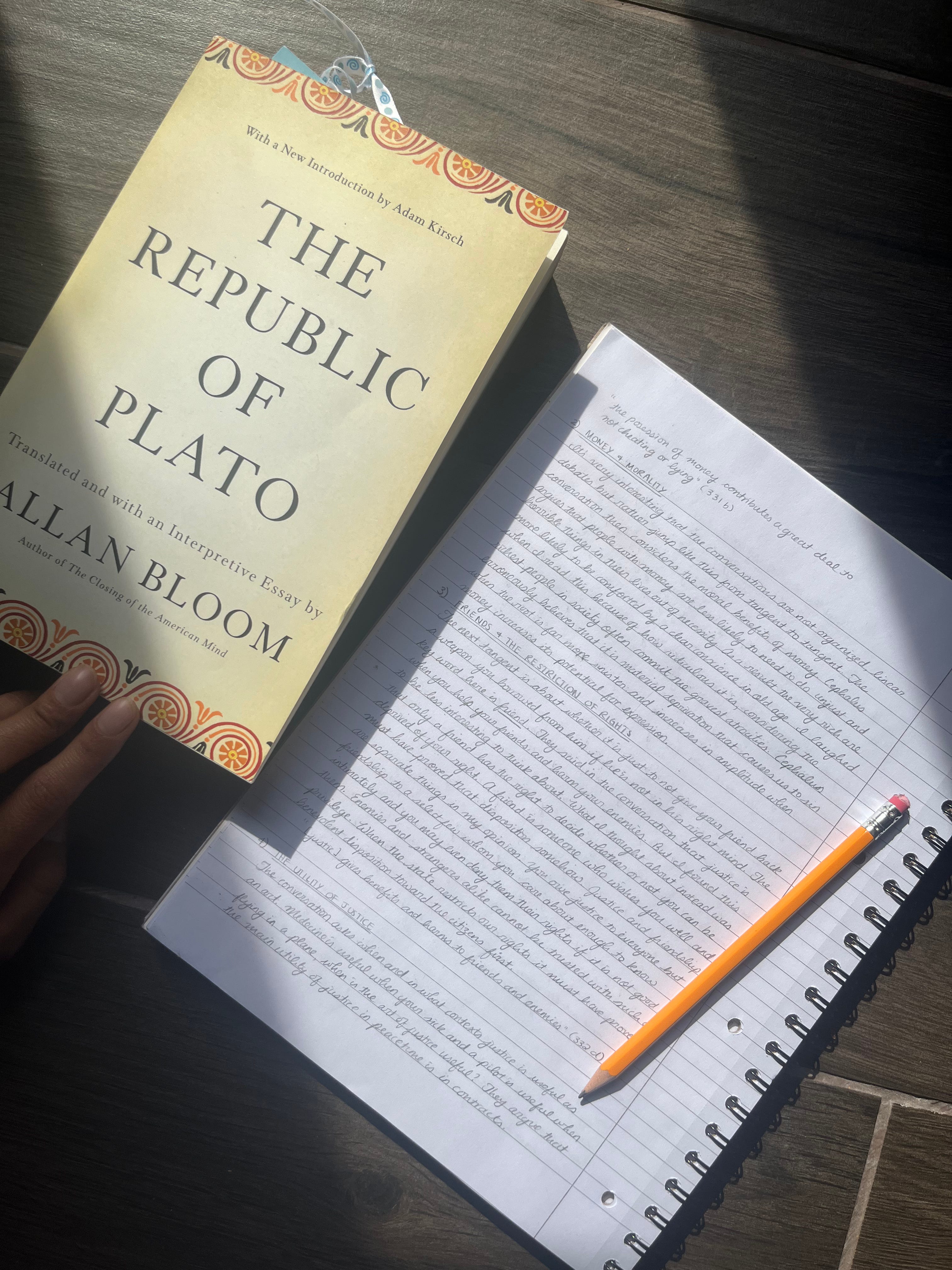
The only type of philosophy I was exposed to in my formal education was Modern Philosophy (Derrida, Sartre, Wittgenstein) which was dense and complicated. If Plato was the patriarch of philosophers, I expected him to be the most complicated of all. However, I was pleasantly surprised by the first chapter of Plato’s Republic because it was so clear. I found myself as the silent third member of an interesting discussion that was taking place between a man named Socrates and his various friends and neighbours and through the discussion you start to feel a warmth toward Socrates himself like a benevolent yet cheeky uncle at a family party.
The first book begins with Socrates visiting a religious festival and getting caught up in one of these discussions about old age, what justice is and whether or not justice is defined by the common argument that “might makes right”. Unlike modern debate formats, these discussions felt more human and natural because they was so unstructured; the characters went on tangents and got emotionally and intellectually distracted. There are even some new insults that I learned along the way.

PART I. Is there anything good about old age?
Socrates encounters a man named Cephalus who says that because he is older, he can’t make as many trips out to see him. This leads to a discussion about how Cephalus thinks that old age is actually quite good because as he grows older, his pleasures connected with the body decrease whereas pleasures associated with the mind increase such as the pleasure in good conversation. Cephalus believes that old age is good because he has fewer masters of the flesh such as lust and hunger, as the impulse reduces so much in an aged body.
I found Cephalus’ argument ironic because he began the whole conversation talking about how his body’s weakness restricted him from taking long trips to visit his friends! Old age may release a person from bodily lusts but it enslaves him to other weaknesses that are not only physical but also mental (in the case of dementias for example). Socrates argues that Cephalus is content in old age because he is rich and wealth can purchase that power of youth that is lost in old age, as wealth can purchase servants and nurses. He proposes that Cephalus undervalues the impact that money has on his ability to enjoy old age because he has inherited his wealth rather than earned it.
PART II. Does money make you more moral?
“The possession of money contributes a great deal to not cheating or lying” (Plato’s Republic Book I, 331b)
Cephalus reflects that one of the problems with old age is that people start to consider on how their souls will be judged in the afterlife; a lifetime of debauchery, dishonesty and vice can lead to golden years that are full of consternation. In this way, Cephalus considers the moral benefits of money to protect a person from the necessity of crime. He concludes that the very rich can lead more honest lives because their material necessities are satisfied. I actually laughed out loud when I read this. The richest people in the world are some of the most debaucherous, vicious and dishonest people who live and this is not a new trend but a very old one. Cephalus erroneously believes that it is material deprivation that causes us to sin when the root is far more sinister and it is only amplified by material power and wealth. Socrates response was that Cephalus’ idea of being a just person was all about giving back what one owed and not stealing, which is incomplete.
PART III. Friends and the Restriction of Rights
“[justice] gives benefits and harms to friends and enemies” (332d)
Socrates considers whether justice is only about giving people back what they’re owed. He tests the idea by asking Cephalus if we should give someone back a weapon we borrowed from them if that person is not in his right mind. The key word I noted was friend. In the conversation it is stated that justice is when you help your friends and harm your enemies. But I was very interested by the idea of friendship and justice. Only a friend has the right to decide whether or not you can be deprived of your right. A friend is someone who wishes you well and must have proved that disposition to you somehow. Justice and friendship are separate things in my opinion. You owe justice to everyone but friendship to a select few whom you care about. It is a right of this intimate relationship to have the power to deny your friends their rights because a friend by definition will have your interest in mind. Enemies and strangers alike cannot be trusted with such a privilege. When the state restricts our rights, it must have proven a benevolent disposition toward its citizens first.
PART IV. The Utility of Justice
The conversation asks when justice is useful. Medicine is useful when you’re sick and a cobbler when you need shoes but what is the use of justice in peacetime? Cephalus, who is ever concerned with money, argues that justice is useful to guard money when it is not being used, in other words, when money is useless. It is argued the justice is useful for “contracts”. This made me think that it is only in societies that have a concept of the future that justice can be invented and prosper because only such societies can consider the value of resources even when they are not actively needed and justice is the system put in place to protect them. Plato also points out an interesting paradox of competence: the one who is most competent at guarding money is the best at stealing it (bankers!) and the one who is most competent at enforcing justice is also the best at conducting injustice.
PART V. On Harming Your Enemy

A character named Polemachus enters the discussion and they discuss whether we ought to harm our enemies. This seems paradoxical because we may even define an enemy as someone we are justified in harming. I remember that this was written long before Jesus Christ said such a thing as “love your enemies” but I can see how this discussion prefigures an inkling of that idea by moving toward a better idea of the word love.
The argument presented by Socrates, that horses become worse after they have been harmed, sounded incomplete to me because animals are certainly trained by harming; a horse runs when it is whipped. This is where I realise the paucity in vocabulary impoverishes this discussion because harm and punishment ought not to be conflated. The threat of violence as punishment works very well as a deterrence to unjust behaviour, especially for those who are not reasonable enough to understand why they ought not to engage in behaviour life theft or murder.
Socrates argues that justice is a human virtue and when human beings are harmed they become worse so they become more unjust. But the project of improving people and protecting the innocent is not one and the same. Protecting the innocent even at the cost of the improvement of the enemy, is a worthy endeavour.
An unjust person who harms others will not become more just if his behaviours are rewarded with good treatment. To treat him “justly” is to harm him in some way that he feels pain, in other words, to punish him. In fact to not punish him in some way that inflicts pain would be more unjust treatment and would make him more unjust a person. Punishment is not always harm and gentle treatment can be harmful when it is unjustly delivered.
PART VI. The Advantage of the Stronger
“Now listen” [says Thrasymachus] “I say that the just is nothing other than the advantage of the stronger” (338c)
The word stronger is translated from the greek kreitton which doesn’t just indicate physical strength but covers many kinds of superiority such as intelligence and excellence. This is the core of Book I where one considers, “does might make right?”
Practically, Thrasymarcus’ argument seems sound: those with the most power and strength have the ability to enforce their ideas of justice onto everyone else because they can compel obedience. Thrasymachus takes it a step further than this by arguing that the stronger don’t merely define and enforce justice, but that justice to them is whatever is advantageous to themselves. He also argues that the unjust man has advantages over the just man because given the opportunity, the unjust man will take more than is his fair share whereas the just man will not. How does Socrates respond?
First, Socrates says that because all men are fallible, it follows that at least sometimes, the stronger may make decisions that are disadvantageous to themselves. Thrasymachus makes an incisive rebuttal by saying that we ought not to define a vocation by the instances of its errors. A cobbler is not a cobbler when he makes a shoe badly so a strong ruler is not a ruler when he is making errors in judgement while ruling.
Second, Socrates says that each craftsman’s virtue or primary motive is not his own advantage but rather the pursuit of excellence in his own craft. Though the craftsman must find some advantage to himself in his vocation (the physician does not work for free) his advantage ought not contradict the quality of his craft. If the stronger rule society as their vocation, the extent to which their “advantage” corrupts their idea of justice, they are no longer excellent in their craft and have done an injustice to themselves by corrupting the virtue of their vocation. When the ruler is no longer true to his virtue as a ruler (which is to deliver justice) even if he gains some material advantage, he has done himself an injustice and degraded himself.
“justice is the virtue of the soul, and injustice is its vice” (335e, Plato’s Republic, Book I)
Next week, I will be back with a summary and thoughts on Book II of Plato’s Republic.
Plato turns familiar assumptions into enduring questions: Is justice a principle, or merely the language of power?
I tried listening to the audiobook last year, and I also was pleasantly surprised to find it's actually a narrative format, like characters come and go and have lives outside of the conversation, and I loved that it started with them doing this after-party, still wearing their party hats and sloshed as it becomes "that time" to get toasted long into the night and talk philosophy. My people!